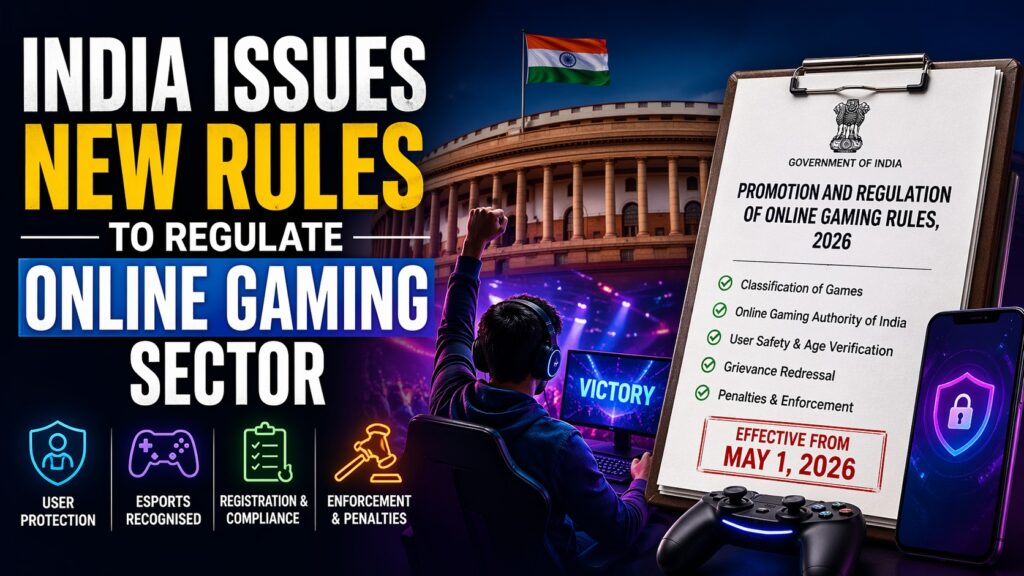

New Delhi — India’s online gaming industry is entering a more structured era. The Indian government has notified the Promotion and Regulation of Online Gaming Rules, 2026, bringing into effect a long-awaited regulatory framework under the PROG Act, 2025. The rules, issued by the Ministry of Electronics and Information Technology (MeitY), will come into force from May 1, 2026.
At the core of the framework is a clear attempt to separate legitimate gaming formats, such as esports and social gaming, from online money gaming, a distinction that has remained blurry and often contentious in India’s regulatory landscape.
The rules mandate the creation of the Online Gaming Authority of India, a central body headquartered in New Delhi. Designed as a digital-first regulator, it will oversee game classification, compliance enforcement, and grievance redressal, while coordinating with financial institutions and law enforcement agencies.
The framework introduces a structured classification system, including a 90-day determination window for identifying whether a game qualifies as esports, social gaming, or falls under prohibited categories.
It also brings in mandatory safeguards for users. The safeguards include age verification, parental controls to time limits. It also establishes grievance mechanisms, signalling a stronger push toward consumer protection in a rapidly expanding digital ecosystem.
Industry stakeholders have largely welcomed the move, calling it a turning point for the sector’s legitimacy and long-term growth.
Akshat Rathee, Co-founder and MD of NODWIN Gaming, described the framework as a “significant positive,” highlighting the clarity around esports classification and the explicit exclusion of online money games.
“Once registered, an esport is unequivocally recognized as a legitimate sporting discipline,” he said, adding that the rules eliminate risks of misrepresentation and bring India closer to global standards.
Similarly, Animesh Agarwal, CEO of S8UL, noted that the framework enables long-term planning for teams and organizations.
“It brings the much-needed structure allowing us to invest in talent and scale with greater confidence,” he said, while pointing out unresolved issues such as financial classification and lack of formal recognition pathways for teams.
Hardware and ecosystem players see broader economic upside. Vishal Parekh of CyberPowerPC India called the move “landmark,” emphasizing that regulatory clarity could unlock investor confidence and global partnerships.
“This strengthens India’s position in the global competitive gaming landscape,” he said, pointing to opportunities in infrastructure, training, and hardware access.
Startups, too, are reading this as a green signal. Sagar Nair from LVL Zero Incubator said the framework reduces long-standing ambiguity that has slowed innovation.
“Clarity in regulation is one of the most critical enablers for innovation,” he noted, adding that the rules could help India emerge as a hub for game development and interactive media.
The rules introduce a registration system for certain categories of games, including esports titles, with certificates valid for up to 10 years. A two tier grievance mechanism that starts with service providers and escalation system to the authority aims to streamline dispute resolution.
While the intent is clear, the real test will be execution. Questions around taxation, banking treatment of esports earnings, and player protections remain open.
Still, for an industry that has operated in regulatory grey zones for years, this is a major reset moment. India is no longer just playing the game, it’s finally writing the rulebook.